[ad_1]
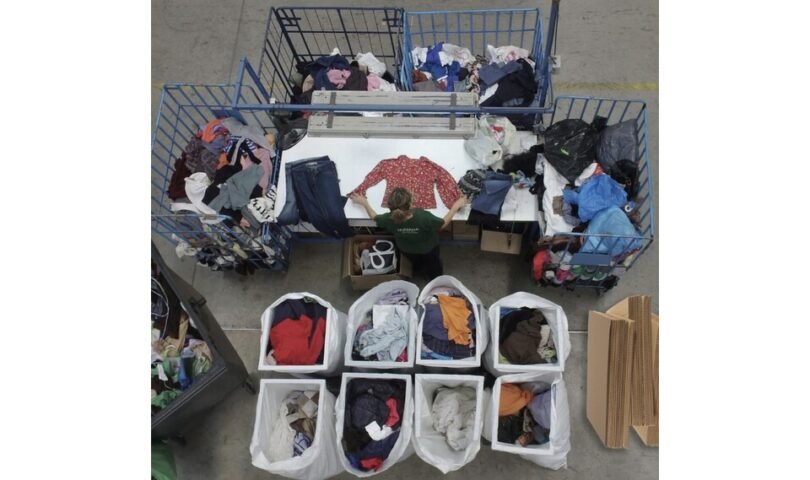
2d-hand clothes (SHC) is stimulating billions of bucks in GDP contributions and supporting loads of hundreds of inexperienced jobs throughout Europe and Africa, a fresh file from Oxford Economics unearths as of late.
OXFORD, England, Oct. 8, 2024 /PRNewswire/ — The file The Socio-Financial Affect of 2d-Hand Garments in Africa and the EU27+ unearths that the field – a very important trait of a generation round textile economic system – stimulated an estimated overall €7 billion ($7.6 billion) overall contribution to the EU and UK’s (EU27+) GDP in 2023, of which the field generated €3.0 billion ($3.2 billion) itself. In Germany and the United Kingdom unloved, the trade contributed €670 million ($720 million) and €420 million ($450 million) to GDP respectively.
In 2023, the field supported an estimated 150,000 jobs within the EU27+. Of those 110,000 had been inexperienced jobs at once within the trade, with alternatives specifically for family with modest formal schooling. 8 out of 10 (79%) of the body of workers had been ladies, and lots of occupation alternatives had been created in lower-income nations reminiscent of Bulgaria, Romania and Poland.
This file is the primary complete research of the field’s complete price chain and an struggle to quantify the field’s socio-economic affects throughout two continents. It addresses current wisdom gaps, providing insights that had been prior to now unavailable at this scale, that specialize in the EU27+ and Ghana, Kenya and Mozambique.
The SHC sector’s luck depends on a well-established price chain between the International North and the International South, producing financial price and inexperienced jobs at each and every degree. The sphere bridges world provide and insist via successfully channelling old clothes from the International North to the International South, the place call for for reasonably priced, component clothes continues to develop, making sure that clothes remains in stream, serving to to satisfy atmosphere goals and give protection to the climate. The sphere additionally contributes to poverty alleviation via growing occupation and entrepreneurship alternatives for individuals who would possibly in a different way be unemployed or underemployed, enabling family to assistance dependents.
In Ghana, second-hand clothes from the EU27+ contributed an estimated $76 million to the rustic’s GDP (of which $35 million was once direct), supporting 65,000 formal and casual jobs in 2023. That very same future, $17 million was once contributed to Kenya’s GDP ($9.2 million at once) and $10.7 million to Mozambique’s ($2.7 million at once). There have been 6,300 family in Kenya’s formal body of workers and no less than 68,000 running informally. In Mozambique, 5,700 formal jobs had been supported and no less than 15,000 casual jobs.
As much as 47% of imported second-hand clothes to Ghana was once from the EU27+ terminating future. This compares to Mozambique’s direct imports from EU27+ accounting for 18% and Kenya’s 13% (now not together with imports arriving by way of middleman nations). Best in Ghana are SHC imports from the EU27+ rising. In Kenya and Mozambique, occasion total SHC imports keep growing, the EU percentage is falling.
The file was once commissioned via Humana Society to Society and Sympany+.
Karina Bolin, President of Humana Society to Society Italy and Bulgaria, mentioned: “This report highlights the immense potential of the second-hand clothing sector to drive sustainable economic growth and create green jobs across continents. Now, more than ever, it is essential for policymakers to recognise the value of this industry and provide the legislative support and investment needed to unlock its full potential as a central factor for building a more resilient, circular economy that benefits both people and the planet.”
Johanna Neuhoff from Oxford Economics mentioned: “Second-hand clothing is often overlooked in the broader debate on sustainable development, yet this report clearly shows its economic power. By keeping clothes in circulation and creating green jobs in both Europe and Africa, the sector delivers significant economic and social benefits. Our findings underscore the need for policies that support and strengthen this circular industry – ensuring it continues to serve as a bridge between environmental sustainability and inclusive economic growth.”
The file displays that with out the suitable regulatory framework, this inexperienced and sustainable sector dangers dropping its aggressive edge to speedy style production giants like China, which proceed to dominate world textile markets generating fresh, inexpensive, degrade component clothes, at a profusion environmental value.
Discussions at EU degree to finalise amends to the Wastage Framework Directive, which impacts the second-hand garments industry, are because of begin then this occasion. This file urges resolution makers excited by those discussions to assistance textile reuse operators. With necessary free textile assortment getting into drive around the EU in January 2025, it’s crucial for those discussions to start and achieve a trade in impulsively, offering sure bet to the field.
If steps don’t seem to be taken to fortify the EU’s SHC sector, its luck in supporting Ecu inexperienced coverage objectives, nationwide atmosphere goals in Africa and the Sustainable Building Targets, specifically round poverty, ladies’s inclusion and accountable intake, may well be undermined.
ABOUT OXFORD ECONOMICS
Oxford Economics was once based in 1981 as a industrial challenge with Oxford College’s industry faculty to serve financial forecasting and modelling to UK corporations and monetary establishments increasing in another country. Since after, we have now transform one of the vital international’s principal distant world advisory corporations, offering experiences, forecasts, and analytical equipment on greater than 200 nations, 100 industries, and eight,000 towns and areas. Oxford Economics is a key helper to company, monetary and executive decision-makers and concept leaders.
https://www.oxfordeconomics.com/
ABOUT HUMANA PEOPLE TO PEOPLE
Humana Society to Society is a Federation of 29 distant associations excited by humanitarian and sustainable construction actions. Participants of the Federation Humana Society to Society are lively in 46 nations in Africa, Asia and Central and South The united states.
In Angola, Guinea-Bissau, Malawi, Mozambique and Zambia, contributors of the Federation Humana Society to Society function a mix of second-hand clothes sorting centres, wholesale retailers and retail retail outlets which can be run as social enterprises. The proceeds from the sale of garments and footwear are invested in social construction tasks in each and every nation. In 2023, Humana Society to Society’s world second-hand clothes operations tied over $31.6 million in construction investment.
ABOUT SYMPANY+
Sympany+ is a Dutch non-governmental group (NGO) devoted to sustainable textile circularity. The group makes a speciality of making a closed-loop device for post-consumer textiles thru diverse tasks and analysis tasks. Moreover, Sympany+ guarantees that each one running situations inside of their tasks adhere to OECD pointers.
Picture – https://mma.prnewswire.com/media/2525567/Europe.jpg
SOURCE Humana Society to Society

WANT YOUR COMPANY’S NEWS FEATURED ON PRNEWSWIRE.COM?

440k+
Newsrooms &
Influencers

9k+
Virtual Media
Shops

270k+
Newshounds
Opted In
[ad_2]
Source link