Education Cannot Wait-funded holistic education response, delivered by World Vision and partners, is helping displaced children regain hope, nutrition and access to learning in Ethiopia
NEW YORK, Dec. 4, 2025 /PRNewswire/ — At 11 years old, Aschila watched her life unravel as conflict swept through her village in northwestern Ethiopia.
Forced to flee with her family, she left behind her home, friends and school. Settling in a new village, survival became the family’s focus. Education seemed like a distant dream, replaced by long days tending cattle to help earn a scant living.
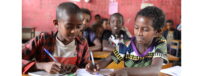
Aschila takes notes with a classmate at her ECW-supported school in Ethiopia. © World Vision/Daniel Kefela
Hope returned when World Vision Ethiopia introduced a school feeding programme in the area – part of a holistic education response delivered by international, national and local partners through the Education Cannot Wait-funded (ECW) Multi-Year Resilience Programme in the country.
By providing school meals, educational materials and cash support – as well as rehabilitating classrooms and water points, constructing latrines, establishing safe learning spaces, offering catch-up and accelerated learning classes, and distributing menstrual hygiene management kits – the programme has made it possible for displaced families like Aschila’s to send their children back to school, and for students to learn in safety and with dignity.
Whole-of-Child support
For Aschila, the ECW-supported programme, which includes a school feeding initiative, was a bridge back to education. The homegrown initiative, using locally sourced ingredients, supplies bread, tea and rice daily, while World Vision’s cash support helps strengthen family livelihoods so children can focus on learning rather than survival.
“The school feeding programme was a game-changer for me. It provided me with a nutritious meal every day, which gave me the energy and focus I needed to succeed in my studies,” she says.
Now enrolled in an accelerated learning programme, Aschila is thriving. Her mornings are spent reading, writing and catching up on lessons she had once feared were lost forever. Her story reflects a broader transformation across Ethiopia, where thousands of children previously denied education are now returning to school thanks to partners like World Vision.
Since the Multi-Year Resilience Programme began, more than 34,000 children – including over 16,400 girls – have benefited from support. Through the whole-of-child education response in the country, ECW partners are tackling barriers to learning, including child hunger and educational exclusion, and providing children like Aschila with a chance to thrive academically and socially. The cost per child for this multi-year programme is around US$65.
The power of such a holistic education response is clear. Quality education that also addresses a child’s mental, emotional and physical needs has the potential to protect, reduce poverty, lessen the chance of conflict, eliminate inequality, improve health, boost economic growth, enhance one’s life and restore peace and stability.
Crisis in Ethiopia
Across Ethiopia, the education system is under immense strain. Conflict, climate shocks, forced displacement and economic hardships are preventing millions of children from learning.
According to UNHCR, 6 million people were internally displaced, stateless or returning from forced displacement within the country at the end of 2024. At the same time, Ethiopia hosts over 1 million refugees and asylum seekers, primarily from South Sudan, Somalia and Eritrea, while also receiving thousands of forcibly displaced people from Sudan. This influx further stretches already limited resources, leaving urgent gaps in education access.
ECW in Ethiopia
Since 2020, ECW-funded programmes in Ethiopia have focused on addressing the critical educational needs of internally displaced and refugee children who are out of school, and improving access to education for girls and children with disabilities.
To date, ECW investments in Ethiopia have totaled US$88 million. In late 2024, ECW announced an additional US$24 million catalyst grant to scale up the multi-year programme’s impact in increasing access and retention of out-of-school girls and boys into non-formal education, improving the quality of foundational learning, supporting children to transition from non-formal accelerated programmes to formal education and improving coordination mechanisms across the humanitarian-development-peace nexus.
Through partnerships with organizations like World Vision, ECW investments are supporting back-to-school campaigns, early childhood education, accelerated learning programmes, catch-up classes, school feeding initiatives, teacher training and other interventions to ensure displaced and crisis-affected children can continue learning despite the multiple challenges around them.
Yet, significant funding gaps remain. By the end of 2024, less than half of the US$101 million required for the education response was funded, according to the 2024 Humanitarian Response Plan. Without increased investment in teacher training, infrastructure repair and inclusive learning alternatives, an entire generation risks being left behind.
By the end of 2024, an estimated 9 million children were out of school. More than 9,000 schools were damaged by conflict and climate shocks – around one-fifth of all schools in the country. The consequences are severe. Children who miss years of schooling face elevated risks of child marriage, child labour, forced recruitment into armed groups and exploitation.
A Future Restored
Today, Aschila wakes each morning with renewed purpose – ready to learn, play, share a meal with her classmates and reclaim the childhood that conflict had taken from her.
Aschila’s father reflects, “It was difficult to feed my child and purchase educational materials because we lost everything as a displaced family, but this initiative helped very much, not just me, but other community members as well, to send our children to school.”
Through programmes like these, ECW and its partners are helping to ensure that children across Ethiopia not only regain their education but also their confidence and hope for a brighter future. For Aschila and thousands like her, every school day is a step toward rebuilding lives disrupted by crisis – and a reminder that learning, nourishment and opportunity can flourish even in the hardest circumstances.
SOURCE Education Cannot Wait