[ad_1]
Stripe paintings respond to newly opened hospital spaces where Vincent van Gogh stayed in 1889–90.
BATH, England, Dec. 9, 2025 /PRNewswire/ — British stripe painter Harry MC has developed a new series of intimate stripe paintings after discovering — and likely becoming the first artist to photograph in detail — a group of rarely seen first-floor rooms at Saint-Paul-de-Mausole in Saint-Rémy-de-Provence, the psychiatric clinic where Vincent van Gogh spent a year in 1889–90.
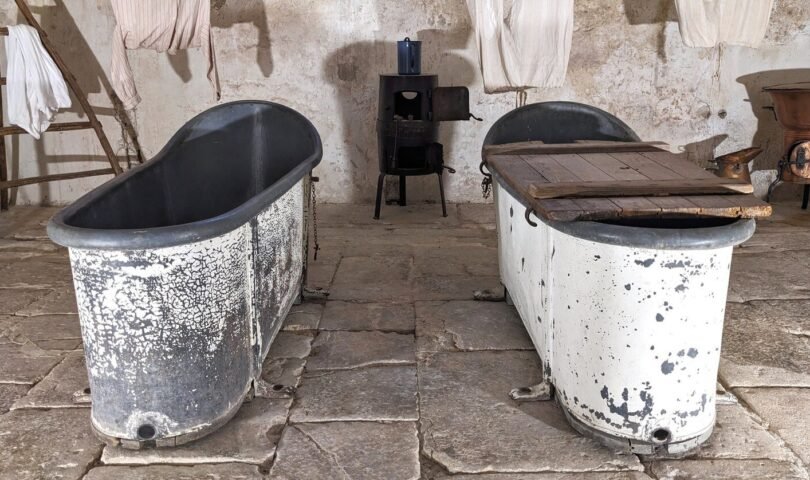
Interior of the historic hydrotherapy room at Saint-Paul-de-Mausole in Saint-Rémy, photographed by British stripe painter Harry MC. The room contains original 19th-century galvanized steel bath tubs, flaking white paint and worn grey flagstones-rarely seen spaces connected to Van Gogh’s 1889-90 treatment. Part of Harry MC’s Provence fieldwork for new contemporary stripe paintings.
One of Harry MC’s new Saint-Rémy stripe paintings (oil on canvas, 24×24 inches, 2025). The vertical composition uses ochre yellows, deep greens, black and white drawn from the Provence landscape and Van Gogh asylum interiors. On one side the stripes are sharply separated; on the other they soften and blur-reflecting light moving through olive groves, hospital corridors and shuttered windows. © Harry MC.
The first-floor rooms remained closed to visitors for decades and have only recently become accessible. They include Dr. Théophile Peyron’s office, a 19th-century pharmacy, nuns’ dormitories, tiled corridors, and the hydrotherapy baths van Gogh described to his brother Theo. In an 1889 letter, van Gogh wrote: “Twice a week I have a bath—cold and hot alternately—which does me a lot of good.”
During a recent Provence fieldwork trip, Harry photographed the newly opened floor not as historical documentation but as working material for stripe painting — tracking verticals, rhythms and shadows as ready-made abstractions.
“The moment I stepped onto the first floor, everything felt naturally geometric,” Harry says. “Tiled corridors receding into doorways, flagstones marching away underfoot, warm and cool stripes of light falling across the walls. I read the rooms the same way I read any place — in verticals, temperatures and rhythms.”
The hydrotherapy room remains especially striking: heavy galvanized steel tubs with flaking paint, sitting on metal feet above broken grey flagstones. Nearby, Dr. Peyron’s office is arranged in warm ochres, while the pharmacy still holds period bottles. These rooms reveal the practical architecture of late-19th-century psychiatric care, an environment built for routine and long recovery.
Completed stripe paintings emerging from this research now appear at harrymc.co.uk. Unlike Harry’s usual large-scale canvases that can reach 10 feet, these new works are small, intimate pieces. One canvas stacks Saint-Rémy ochre yellows, deep greens and black into shifting vertical lines: on one side the stripes are sharply separated, on the other they soften and blur, as if the colours were still moving through olive groves, corridors and window light. Each painting is built with Harry’s dry-brush technique, allowing earlier layers to soften through rather than snap into hard edges.
“The structure stays vertical,” he says, “but the colour stays human.”
A set of 12 Saint-Rémy interior photographs can be viewed on the “Provence Fieldwork” page at harrymc.co.uk. High-resolution files are available for editorial use by request.
About Harry MC: Harry MC is a British stripe painter working between his studio in the Georgian city of Bath and fieldwork in Provence. His vertical stripe paintings explore how colour carries light, architecture and lived experience — extending a lineage that includes Bridget Riley, Gene Davis and Sean Scully — they are built slowly, one stripe at a time.
SOURCE Harry MC

[ad_2]
Source link